OnlyFans promotional banners are everywhere, but most of them are not temporary events — they are the everyday price dressed up in discount language. The direct answer: if a page has carried the same “50% off” banner for months, that reduced figure is the real price, and you will pay it every renewal cycle without any further cut.
This guide covers how discount formats are structured on the platform, how to tell a permanent markdown from a genuine limited offer, how to check an offer’s history before committing, and what to do after you subscribe so the renewal charge does not catch you off guard.
How Promotions Are Displayed
The platform gives creators a small toolkit of promotional formats. Each looks different on the subscription button, but they all reduce what you pay for a defined period — or indefinitely, depending on how the creator has set it up.
- Percentage-off first month: A banner shows 30–70% off the listed price. The reduced amount covers month one only; renewal charges the full base price.
- Trial window: A very short free or low-cost access period, sometimes just a few days, after which the full subscription kicks in automatically.
- Bundle pricing: Paying 3, 6, or 12 months upfront at a lower monthly rate than the standard price. The saving is real, but you pay the whole sum at once with no refund if you cancel early.
- Permanent discount banner: The creator sets a reduced price and leaves the “X% off” label in place indefinitely. The discounted figure becomes the actual recurring charge.
- Follower-only offers: A time-limited code or link sent to people who already follow the free version of a page, typically valid for 24–72 hours.
Real Discount or Real Price
The table below maps the common patterns to what they mean at renewal. Base subscriptions run from $4.99 to $49.99 per month; the mid-market majority sits between $6 and $10. Only promotional first months and trials can legally fall below $4.99 — no standard recurring charge ever does.
| Pattern |
What it usually means |
What you pay long term |
| Permanent “% off” banner, months old |
Discounted figure is the creator’s chosen base price |
That same discounted figure every cycle |
| Rare, time-stamped cut (24–72 h) |
Genuine promotional event, likely tied to a milestone or campaign |
Full base price from month two onward |
| Deep first-month offer (below $4.99) |
Acquisition tactic; renewal always reverts to full price |
Full base price — often $9.99–$14.99 |
| 3/6/12-month bundle |
Genuine per-month saving, paid upfront as a lump sum |
No renewal until bundle expires; then full monthly rate |
One important note on existing subscribers: if you are already subscribed and the creator raises their price, your rate stays locked at the figure you signed up at. New subscribers pay the new rate. This means long-term subscribers sometimes pay less than someone who joins during a promotional window and then renews at the higher full price.
Why Permanent Discounts Exist
A creator competing on price rather than content retention has an incentive to leave a discount banner running indefinitely. It signals value on the subscription button without changing the actual economics — the discounted figure simply becomes the market price for that page. Some creators set a higher “list price” specifically so the percentage looks larger, even though the page has never charged the full listed amount to anyone.
This is not a deceptive practice in itself; it is standard pricing psychology. The problem for subscribers is that the urgency implied by a discount label is meaningless when the offer never expires. Tracking services like ranking sites log price histories across large numbers of pages, which makes it straightforward to check whether a listed discount has been in place for days or for a year.
Checking an Offer Against History
Before you commit, spend three minutes running the checks in the table below. The goal is to separate a page that is genuinely running a short campaign from one that permanently advertises a markdown.
| Check |
Where to look |
What it tells you |
| Price history |
these listings price-tracking cards |
Whether the “discounted” figure is the real recurring price |
| Promo frequency |
BestOnlyFans promotion log; fan forums |
How often deals appear — frequent = permanent marketing |
| Renewal rate after first month |
Subscription confirmation email; account billing tab |
The exact charge that will hit next cycle |
| Archive growth |
Media count on the profile card over time |
Whether new content is being added or the page is stale |
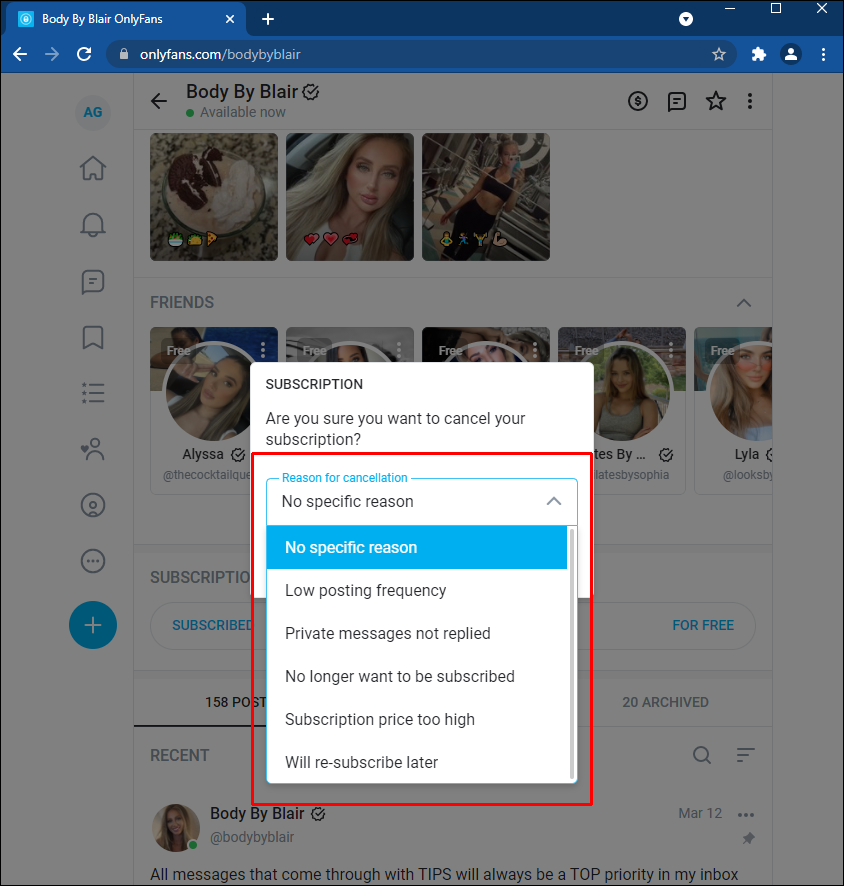
Practical warning: Auto-renew charges every cycle even if you never open the site. A processed charge is not refunded under the platform’s no-refund policy. If you decide the page is not worth renewing, turn off Auto-Renew at least 24 hours before the next billing date: profile icon → Subscriptions → creator card → Auto-Renew toggle → select a reason → confirm. You keep access until the period ends unless you also choose the unfollow option, which removes access immediately.
Before You Accept an Offer
Run these steps in order before entering payment details. Each step takes under a minute.
- Find the full base price, not the promotional figure. It is listed below or beside the discount banner.
- Check how long the current offer has been live using BestOnlyFans or a fan directory that logs pricing.
- Read the subscription confirmation preview — it states the renewal amount and date before you confirm.
- Decide whether you want the bundle or the monthly option, keeping in mind that bundles are non-refundable.
- Set a calendar reminder for 48 hours before the renewal date so you have time to cancel if needed.
Offers That Usually Are Worth It
Not every promotion is noise. The following types tend to deliver genuine value relative to what you would pay without the offer.
- Short follower-only windows (24–72 h): Sent to existing free followers, these are usually real events tied to a content drop or milestone rather than permanent banners.
- Bundles on pages with consistent posting history: If a page shows steady media count growth over several months, locking in a lower monthly rate for 6 or 12 months is a straightforward saving.
- First-month offers on pages you were already watching: Using a discount to test a page you already follow on free social accounts costs less than subscribing at full price to find out it is not for you.
- Price-lock on a creator who recently raised rates: If you subscribe before a announced price increase, your rate stays at the lower figure for as long as you remain subscribed.
Offers to Walk Past
Some promotional patterns consistently fail to deliver the saving they appear to advertise. Recognising them saves both money and frustration. Many onlyfans best creators directories flag these patterns explicitly in their listing notes.
- Permanent “limited time” banners: If a price-history check shows the offer has been live for more than a few weeks, it is the real price — not a discount.
- Deep first-month cuts on pages with a high base price: A $1 first month that renews at $29.99 is only worth taking if you are certain you will cancel before the billing date.
- Bundles on inactive pages: Paying 6 months upfront on a page whose last post is several weeks old locks money into an archive you could have accessed for one month.
- Urgency language without a visible end date: “Ends soon” or “almost gone” with no timestamp is a design choice, not factual information about the offer’s expiry.
After You Take an Offer
Once you subscribe, record a few details immediately. The renewal charge is the most common source of billing surprises, and the no-refund policy means there is no recovery if you miss the cancellation window. Pages listed across multiple independent ranking sites — including those that track sexy only fans pages by price tier and activity — sometimes update their promo data within days of a change, so checking back after subscribing is worth doing once more before your first renewal.
- Note the exact renewal amount shown in the confirmation email — this is the figure that will charge next month, not the promotional price.
- Note the renewal date and set a reminder at least 48 hours before it.
- Screenshot or save the subscription details page so you have a record of the rate you accepted.
- Check the billing tab in account settings after the first charge processes to confirm the amount matches what was stated.
- If you use a bundle, note the bundle expiry date separately — the renewal to monthly billing after a bundle ends is easy to miss.
FAQ
Can a creator change their price after I subscribe?
Yes, creators can raise their base price at any time, but the change only affects new subscribers — your rate is locked at the price you paid when you signed up, and it stays at that figure for as long as your subscription remains active.
Is there any way to get a refund if I forget to cancel before renewal?
The platform’s policy is that processed charges are not refunded, so a charge that has already been collected cannot be reversed through normal support channels; the only reliable protection is cancelling auto-renew at least 24 hours before the billing date.
How do I know if a discount I see has been running for a long time?
Price-tracking tools — BestOnlyFans is the most commonly used among subscribers — log historical pricing for a large number of pages, so you can check the timeline of the current offer against past prices in under a minute before deciding whether to subscribe.
What is the difference between cancelling and unfollowing?
Cancelling means turning off Auto-Renew, which stops future charges while keeping your access until the current paid period ends; unfollowing removes your access immediately, so choose the disable-rebill-only option if you want to keep access until the date you have already paid for.


Reading OnlyFans Promotions Without Getting Caught Out
OnlyFans promotional banners are everywhere, but most of them are not temporary events — they are the everyday price dressed up in discount language. The direct answer: if a page has carried the same “50% off” banner for months, that reduced figure is the real price, and you will pay it every renewal cycle without any further cut.
This guide covers how discount formats are structured on the platform, how to tell a permanent markdown from a genuine limited offer, how to check an offer’s history before committing, and what to do after you subscribe so the renewal charge does not catch you off guard.
How Promotions Are Displayed
The platform gives creators a small toolkit of promotional formats. Each looks different on the subscription button, but they all reduce what you pay for a defined period — or indefinitely, depending on how the creator has set it up.
Real Discount or Real Price
The table below maps the common patterns to what they mean at renewal. Base subscriptions run from $4.99 to $49.99 per month; the mid-market majority sits between $6 and $10. Only promotional first months and trials can legally fall below $4.99 — no standard recurring charge ever does.
One important note on existing subscribers: if you are already subscribed and the creator raises their price, your rate stays locked at the figure you signed up at. New subscribers pay the new rate. This means long-term subscribers sometimes pay less than someone who joins during a promotional window and then renews at the higher full price.
Why Permanent Discounts Exist
A creator competing on price rather than content retention has an incentive to leave a discount banner running indefinitely. It signals value on the subscription button without changing the actual economics — the discounted figure simply becomes the market price for that page. Some creators set a higher “list price” specifically so the percentage looks larger, even though the page has never charged the full listed amount to anyone.
This is not a deceptive practice in itself; it is standard pricing psychology. The problem for subscribers is that the urgency implied by a discount label is meaningless when the offer never expires. Tracking services like ranking sites log price histories across large numbers of pages, which makes it straightforward to check whether a listed discount has been in place for days or for a year.
Checking an Offer Against History
Before you commit, spend three minutes running the checks in the table below. The goal is to separate a page that is genuinely running a short campaign from one that permanently advertises a markdown.
Before You Accept an Offer
Run these steps in order before entering payment details. Each step takes under a minute.
Offers That Usually Are Worth It
Not every promotion is noise. The following types tend to deliver genuine value relative to what you would pay without the offer.
Offers to Walk Past
Some promotional patterns consistently fail to deliver the saving they appear to advertise. Recognising them saves both money and frustration. Many onlyfans best creators directories flag these patterns explicitly in their listing notes.
After You Take an Offer
Once you subscribe, record a few details immediately. The renewal charge is the most common source of billing surprises, and the no-refund policy means there is no recovery if you miss the cancellation window. Pages listed across multiple independent ranking sites — including those that track sexy only fans pages by price tier and activity — sometimes update their promo data within days of a change, so checking back after subscribing is worth doing once more before your first renewal.
FAQ
Can a creator change their price after I subscribe?
Yes, creators can raise their base price at any time, but the change only affects new subscribers — your rate is locked at the price you paid when you signed up, and it stays at that figure for as long as your subscription remains active.
Is there any way to get a refund if I forget to cancel before renewal?
The platform’s policy is that processed charges are not refunded, so a charge that has already been collected cannot be reversed through normal support channels; the only reliable protection is cancelling auto-renew at least 24 hours before the billing date.
How do I know if a discount I see has been running for a long time?
Price-tracking tools — BestOnlyFans is the most commonly used among subscribers — log historical pricing for a large number of pages, so you can check the timeline of the current offer against past prices in under a minute before deciding whether to subscribe.
What is the difference between cancelling and unfollowing?
Cancelling means turning off Auto-Renew, which stops future charges while keeping your access until the current paid period ends; unfollowing removes your access immediately, so choose the disable-rebill-only option if you want to keep access until the date you have already paid for.